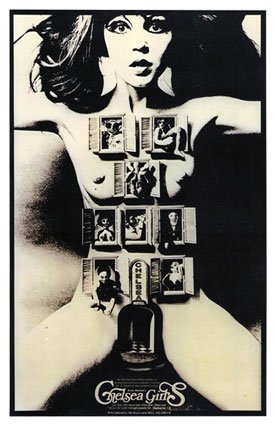
Rating: 7.1/10
Runtime: 210 min
Language: English
Country: USA
Color: Black and White | Color
Director:
Brigid Berlin as herself (The Duchess)
Nico as herself
Ondine as himself (Pope)
Ingrid Superstar as herself
Randy Bourscheidt as himself
Angela 'Pepper' Davis as herself
Christian Aaron Boulogne (Nico's son) as himself (as Ari)
Mary Woronov as Hanoi Hannah
Ed Hood as himself
Ronna as herself
International Velvet as herself
Rona Page as herself
Albert Rene Richard as himself
Dorothy Dean as herself
Patrick Flemming as himself
Eric Emerson as himself
Donald Lyons as himself
Edie Sedgwick as herself (footage cut)
Gerard Malanga as Son
Marie Menken as Mother
Arthur Loeb as himself
Mario Montez as Transvestite
Description: Chelsea Girls is a 1966 experimental
Chelsea Girls does not follow a clear narrative, but rather solely consists of three hours of raw footage that focuses on various long-term guests (primarily women and Warhol superstars) staying in the Chelsea Hotel, and their everyday interactions with each other - from the mundane to flamboyant. The film is presented in a split screen, with two separate things occurring on both sides of the screen simultaneously; however, of the two audio tracks attached to each scene, only one is played in conjunction with what is onscreen; the other side remains silent. In live projection, this is accomplished by the projectionist manually changing the volume between the two projectors while referring to an instruction guide that comes with the reels. Additionally, each side alternates its scenes between black and white and color photography.
IMDb Link:
http://www.imdb.com/title/tt0061465/
Download
http://rapidshare.com/files/255613793/ChelseaGirls.part01.rar
http://rapidshare.com/files/255634281/ChelseaGirls.part02.rar
http://rapidshare.com/files/255634384/ChelseaGirls.part03.rar
http://rapidshare.com/files/255648179/ChelseaGirls.part04.rar
http://rapidshare.com/files/255659577/ChelseaGirls.part05.rar
http://rapidshare.com/files/255688064/ChelseaGirls.part06.rar
http://rapidshare.com/files/255701351/ChelseaGirls.part07.rar
http://rapidshare.com/files/255716260/ChelseaGirls.part08.rar
http://rapidshare.com/files/255732239/ChelseaGirls.part09.rar
http://rapidshare.com/files/255749749/ChelseaGirls.part10.rar
http://rapidshare.com/files/255763942/ChelseaGirls.part11.rar
http://rapidshare.com/files/255789297/ChelseaGirls.part12.rar
http://rapidshare.com/files/255803787/ChelseaGirls.part13.rar
http://rapidshare.com/files/255829642/ChelseaGirls.part14.rar
http://rapidshare.com/files/255865014/ChelseaGirls.part15.rar
http://rapidshare.com/files/255883501/ChelseaGirls.part16.rar
http://rapidshare.com/files/255886477/ChelseaGirls.part17.rar
http://rapidshare.com/files/255893890/ChelseaGirls.part18.rar
Rar Password: None
Production
According to script-writer Ronald Tavel, Warhol first brought up the idea for the film in the back room of Max's Kansas City, Warhol's favorite nightspot, during the summer of 1966. In Ric Burns' documentary film Andy Warhol, Tavel recollected that Warhol took a napkin and drew a line down the middle and wrote 'B' and 'W' on opposite sides of the line; he then showed it to Tavel, explaining, "I want to make a movie that is a long movie, that is all black on one side and all white on the other." Warhol was referring to both the visual concept of the film, as well as the content of the scenes presented.
The film was shot in the summer and early autumn of 1966 in various rooms and locations inside the Hotel Chelsea, although it is worth noting that of all those who starred in the film, only poet René Ricard actually lived there at the time. Filming also took place at Warhol's studio The Factory. Appearing in the film were many of Warhol's regulars, including Nico, Brigid Berlin, Gerard Malanga, Ingrid Superstar, International Velvet and Eric Emerson. According to Burns' documentary, Warhol and his companions completed an average of one 33-minute segment per week.
Once principal photography wrapped, Warhol and co-director Paul Morrissey selected the twelve most striking vignettes they had filmed and then projected them side-by-side to create a visual juxtaposition of both contrasting images and divergent content (the so-called "white" or light and innocent aspects of life against the "black" or darker, more disturbing aspects.) As a result, the 6 1/2 hour running time was essentially cut in half, to 3 hours and 15 minutes. However, part of Warhol's concept for the film was that it would be unlike watching a regular movie, as the two projectors could never achieve exact synchronization from viewing to viewing; therefore, despite specific instructions of where individual sequences would be played during the running time, each viewing of the film would, in essence, be an entirely different experience.
Several of the sequences have gone on to attain a cult-status, most notably the "Pope" sequence, featuring avant-garde actor and poet Robert Olivo, or Ondine as he called himself, as well as a segment featuring Mary Woronov entitled "Hanoi Hannah," one of two portions of the film scripted specifically by Tavel.
Notably missing is a sequence Warhol shot with his most popular superstar Edie Sedgwick which, according to Morrissey, Warhol excised from the final film at the insistence of Sedgwick herself, who claimed she was under contract to Bob Dylan's manager, Albert Grossman, at the time the film was made.
Critical reception
Although the film garnered the most commercial success of Warhol's films, reaction to it was mixed.
Roger Ebert reviewed the film in June 1967, and had a negative response to it, granting it one star out of four. In his review of the film, he stated "...what we have here is 3 1/2 hours of split-screen improvisation poorly photographed, hardly edited at all, employing perversion and sensation like chili sauce to disguise the aroma of the meal. Warhol has nothing to say and no technique to say it with. He simply wants to make movies, and he does: hours and hours of them."Kenneth Baker of the San Francisco Chronicle reviewed the film in honor of its screening in the bay area in 2002, and gave the film a rather positive review, stating "The tyranny of the camera is the oppression The Chelsea Girls records and imposes. No wonder it still seems radical, despite all we have seen onscreen and off since 1966."
TV Guide reviewed the film in December 2006, granting it four stars, calling it "fascinating, provocative, and hilarious", and "a film whose importance as a 1960s cultural statement outweighs any intrinsic value it may have as a film.
Internet film review aggregator Rotten Tomatoes has the film ranked as 57% "fresh", or positive, out of eight collected reviews.


No comments:
Post a Comment